
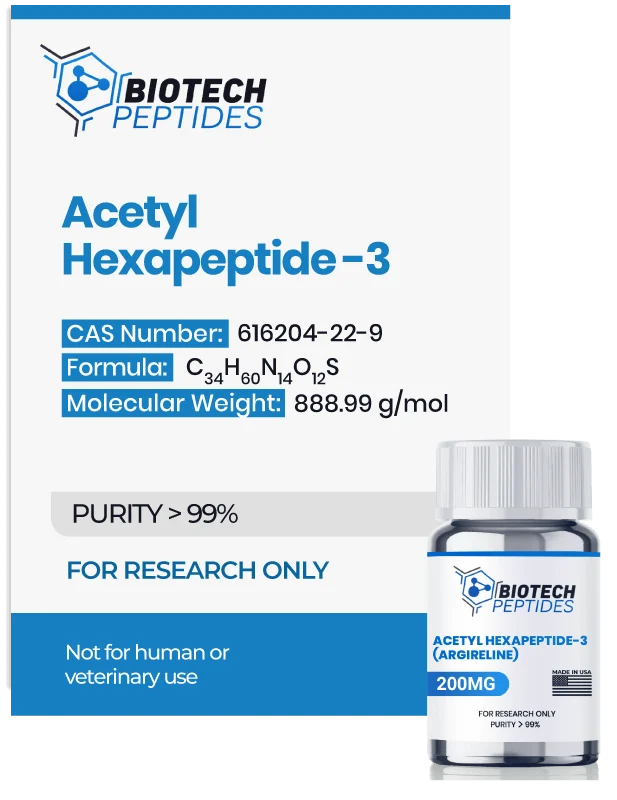
Acetyl Hexapeptide-3 (Argireline) Peptide
Acetyl Hexapeptide 3 (Argireline) is an amino-acid peptide made up of the sequence Ac-Glu-Glu-Met-Gln-Arg-Arg-NH2. It functions as a fragment derived from SNAP-25 (synaptosome-associated protein 25 kDa). SNAP-25 plays an essential role within the SNARE (Soluble N-ethylmaleimide-sensitive factor Attachment protein Receptor)-Synaptotagmin-1 complex. This protein complex helps enable neurotransmitter release, including acetylcholine, into the synaptic gap between nerve endings and muscle cells. SNAP-25 is viewed as crucial to this mechanism because it appears to participate in forming the SNARE complex. That formation can promote acetylcholine release, which then initiates muscle contraction. Acetyl Hexapeptide-3 closely mimics SNAP-25, especially the region thought to be required for SNARE complex assembly.
By inhibiting its formation, the peptide may also prevent neurotransmitter release and muscle contraction. Researchers have investigated Acetyl Hexapeptide-3 (Argireline) for its potential to support skin cell structure and reduce wrinkling along the stratum corneum. Continuous muscle movements result in wrinkling, and the devitalization of muscle contractions may possibly inhibit the development of new lines and decrease the depth of existing skin tissue creases and wrinkles. Acetyl Hexapeptide-3 (Argireline) may prevent muscles from moving or contracting. Researchers also posit that the peptide may support endogenous collagen production to preserve the skin’s extracellular matrix.
Specifications
Sequence: Ac-Glu-Glu-Met-Gln-Arg-Arg-NH2
Molecular Formula: C34H60N14O12S
Molecular Weight: 888.99 g/mol
Synonyms: Acetyl hexapeptide, Argireline, Argireline Acetate
Acetyl Hexapeptide-3 (Argireline) Research
Acetyl Hexapeptide-3 (Argireline) and Wrinkles
Acetyl Hexapeptide-3 (Argireline) appears to have the potential to halt the production of the neurotransmitters that influence and control the contractile force of certain muscle groups. Acetyl Hexapeptide-3 (Argireline) may hamper the protein complex that controls muscle movement and limit muscle contractions via reducing the action of nerves that control contractions. According to research, the peptide may potentially act to reduce the depth of wrinkles and lines along the surface of skin tissues through supporting the endogenous synthesis of proteins integral to the skin’s extracellular matrix, such as collagen.[2]
Researchers noted that introducing the peptide alongside “functional [symbiotic compounds] [may] improve wrinkle” depth and breadth. Scientific research suggests that it may be a vital ancillary for reducing existing creases along the skin barrier, even as it works to support collagen production.
Acetyl Hexapeptide-3 (Argireline) studies report a range of findings, from its actions on wrinkles appearing minimal, to definitive and evident.[3,4] According to the research, a cream with a 10% concentration of Acetyl Hexapeptide-3 (Argireline) decreased the wrinkle formations of laboratory models in a specific area by 30% after one month of exposure. Researchers studied a serum consisting of Acetyl Hexapeptide-3 (Argireline) twice a day for a month. After which, the results posited a total decrease in periorbital wrinkle depth at 27%.
The in vitro experiment suggests that the actions of Acetyl Hexapeptide-3 may potentially halt the release of neurotransmitters. Blanes-Mira et al. noted that “Taken together, these findings [indicate] that Argireline is a non-toxic, anti-wrinkle peptide that emulates the action of currently used BoNTs” suggesting a reduction in wrinkle formation due to limited muscle contraction.[5]
Acetyl Hexapeptide-3 (Argireline) and Skin Hydration
Acetyl Hexapeptide-3 experiments suggest that the peptide may influence the properties of skin tissue models and potentially increase water retention within skin tissues of test models. Once study posited that there was a decrease in transepidermal water loss (TEWL) following Acetyl Hexapeptide-3 exposition, when compared to placebo.[6]
Acetyl Hexapeptide-3 (Argireline) (200mg)
In a study, Acetyl Hexapeptide 3 has been investigated for its potential to ameliorate muscle twitching models.[7] More specifically, the researchers suggested that the peptide may interact with the mechanisms behind different neurotoxins typically employed in such models, potentially enhancing and prolonging their actions. The data from the study indicated that models exposed to both Acetyl Hexapeptide-3 and the neurotoxin experienced a delayed return to baseline twitching compared to those in the neurotoxin-only group. Specifically, the average time until return to baseline was 3.7 months for the Acetyl Hexapeptide-3 group versus 3.0 months for the control cohort. Although this difference did not achieve statistical significance, it suggests a trend where Acetyl Hexapeptide-3 may extend the neurotoxin’s potential. Furthermore, in one-third of the models in the active group, the duration between required neurotoxin exposure was notably extended, ranging from 3.3 to 7.1 months. This suggests that Acetyl Hexapeptide-3 may contribute to a prolonged reduction in muscle twitching by possibly stabilizing the neurotoxin’s suppression of neurotransmitter release.
Acetyl Hexapeptide 3 (Argireline) and Changes with Palmitic AcidResearchers have modified Acetyl Hexapeptide-3 with palmitic acid. This creates Palmitoyl Hexapeptide-3 and may change its effects in nociception research. In mouse models, it appears to reduce pain-like responses. These include chronic inflammatory pain and neuropathic pain models. The palmitoylated form is linked to less thermal hyperalgesia and mechanical allodynia.[8] The study also suggests this change may prolong antinociceptive action. This longer effect may come from better stability in the neuronal membrane. This may help it stay longer at the target site. Researchers also suggest it may block TRPV1 channel recruitment during exocytosis. TRPV1 channels can help transmit pain signals during inflammation. If fewer TRPV1 channels enter the membrane, nociceptors may be less excitable. This may lower overall pain signaling.
Disclaimer: These products are not for human or animal consumption. Research chemicals are only for lab work and in vitro testing. Any bodily use is strictly forbidden by law. Purchases are limited to licensed researchers and qualified professionals. This article is for educational purposes only.
Reviews
There are no reviews yet.